
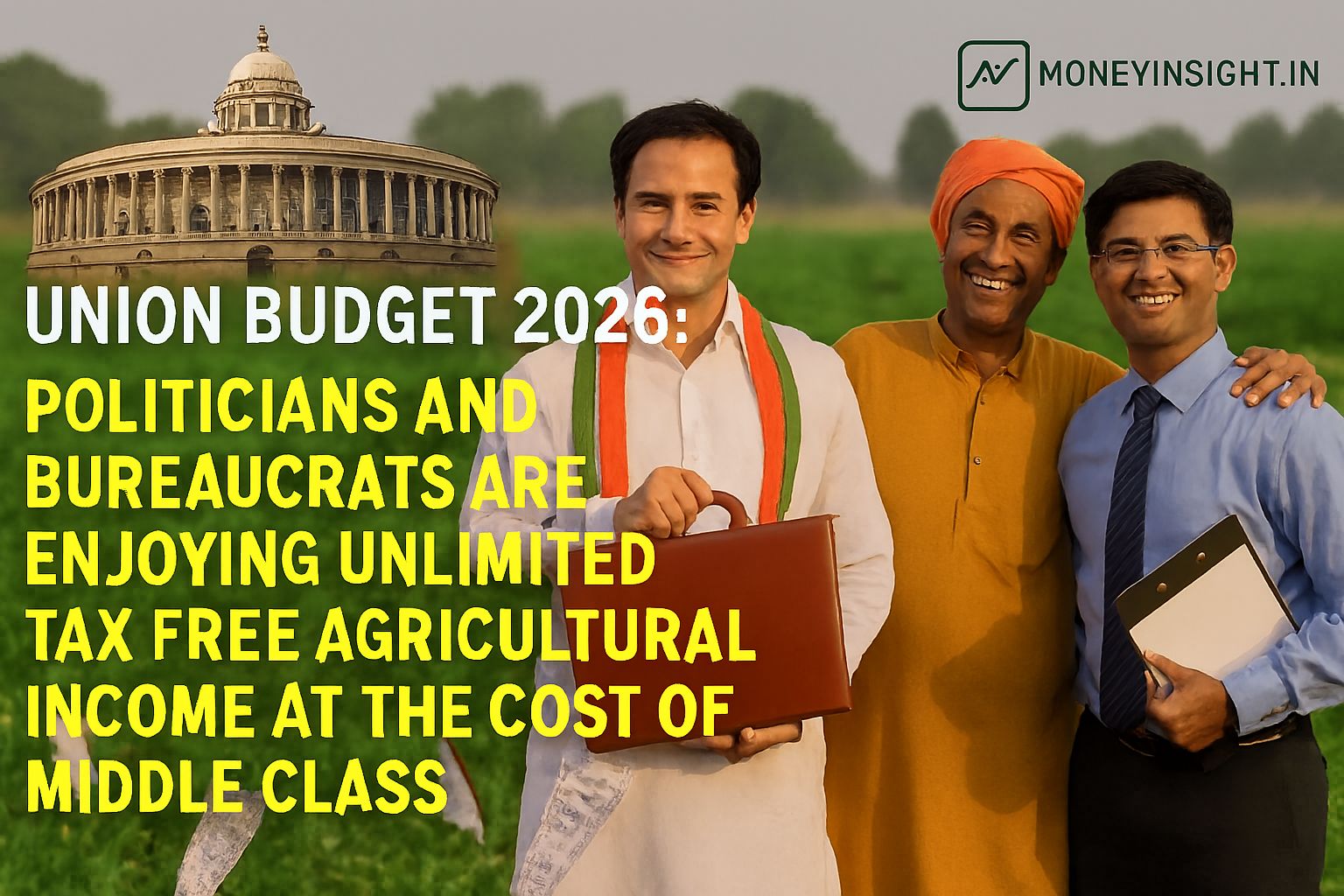
Union Budget 2026 once again sidesteps the politically sensitive issue of taxing agricultural income, while tightening the tax net on the middle class. This imbalance raises questions about fairness, accountability, and the government’s priorities in revenue generation.
Agricultural Income: The Untouched Territory
• Agricultural income in India remains fully exempt from income tax, a policy rooted in the colonial era and justified by the need to protect farmers.
• However, large landowners, politicians, and bureaucrats often exploit this exemption, routing non-agricultural earnings through agricultural accounts to launder money.
• This loophole has been flagged repeatedly by economists and tax experts, yet successive governments have avoided reform due to the political sensitivity of taxing farmers.
Union Budget 2026: Burden on the Middle Class
Finance Minister Nirmala Sitharaman’s ninth consecutive budget, presented today, focused heavily on infrastructure, semiconductor manufacturing, and capital expenditure. While these investments may boost long-term growth, the immediate tax burden continues to fall disproportionately on the salaried middle class:
• Hike in Securities Transaction Tax (STT) and new penalties on taxpayers were announced, tightening compliance requirements.
• Buyback taxes for promoters and stricter rules on financial transactions were introduced, indirectly affecting retail investors.
• No relief in personal income tax slabs or deductions, despite rising inflation and stagnant wage growth.
• The government emphasized fiscal discipline, but this discipline seems to come at the expense of the middle-income group, which contributes the bulk of direct taxes.
The Contradiction
• Agricultural sector already receives subsidies, loan waivers, and support schemes, yet remains outside the tax net.
• Meanwhile, middle-class taxpayers fund infrastructure, welfare, and subsidies without significant returns in terms of healthcare, education, or social security.
• This creates a two-tier system: one group shielded from taxation regardless of income level, and another squeezed harder each year.
Why the Government Avoids Agricultural Taxation
1. Political Sensitivity: Farmers form a large voting bloc, and taxing them risks electoral backlash.
2. Administrative Complexity: Differentiating between small farmers and large agribusinesses is challenging.
3. Populist Narrative: Agriculture is portrayed as a struggling sector, even though many wealthy individuals own vast tracts of land.
The Way Forward
• Introduce a threshold-based agricultural tax: Small farmers should remain exempt, but large landowners and agribusinesses earning beyond a certain limit must contribute.
• Strengthen monitoring of agricultural income declarations to prevent laundering.
• Balance tax reforms by easing the burden on the middle class through higher deductions, rationalized GST, and better social security measures.
Conclusion
Union Budget 2026 highlights India’s commitment to infrastructure and industrial growth, but fails to address the glaring inequity in its tax structure. By continuing to exempt agricultural income while increasing compliance and tax burdens on the middle class, the government risks deepening resentment among honest taxpayers. True fiscal discipline requires broadening the tax base fairly, not leaning endlessly on the same segment of society.
Read Also:
Also Read :
How to make money from share market? (indiatimes.com)
Visit our another Group Website regularly for more such Educational Research Articles:
How to make maximum profit with minimum investment from the Stock Market ? – MoneyInsight
Visit & Subscribe our Devotional Music Channel on YouTube:
Indian Devotional Music – YouTube
Visit our Website regularly for more such Educational Research Articles:
MoneyInsight – We Provide Insight to Your Money